
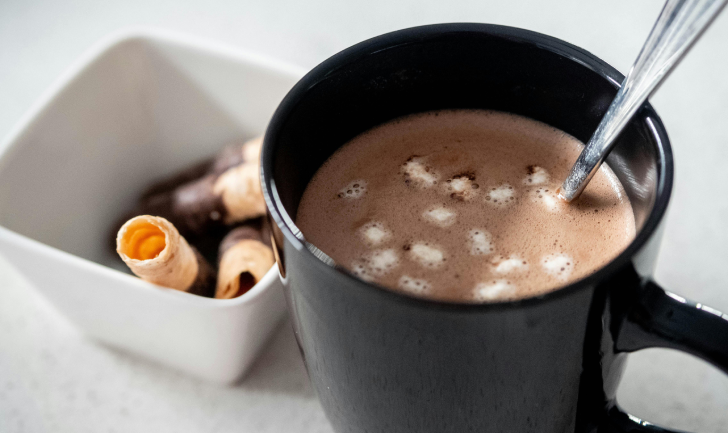
Cocoa Day
National Cocoa Day is celebrated on December 13th each year in the United States. It’s a day dedicated to enjoying one of the world’s favorite comfort drinks—hot cocoa! While its exact origin isn’t well documented, Cocoa Day likely emerged as a fun way to honor the rich history of cocoa, which dates back thousands of years to the ancient Mayans and Aztecs. Cocoa was originally consumed as a bitter drink mixed with spices, and over time evolved into the sweet, creamy beverage we know today. People mark the day by making hot cocoa at home, experimenting with toppings like whipped cream, marshmallows, or peppermint. Cafés often run special promotions, and social media fills up with cozy cocoa photos. Cocoa is not only delicious but also contains antioxidants and compounds that can boost mood—perfect for chilly December days!

Violin Day
Violin Day is celebrated every year on December 13th to honor one of the most beloved and versatile musical instruments in history—the violin. While the exact origin of Violin Day is unclear, it exists to appreciate the artistry, craftsmanship, and cultural impact of the violin. The violin dates back to the 16th century in Italy, evolving from earlier bowed instruments like the rebec and lira da braccio. The violin is central to classical music, folk traditions, jazz, and even modern genres. Famous makers like Stradivari and Guarneri elevated violin-making to an art form, creating instruments that are still revered today.

December 13th has been a significant date throughout history, marked by notable events, birthdays, and historical milestones.
Historical Events:
1545 – The Council of Trent Begins:
The Catholic Church convened the Council of Trent in northern Italy to address the Protestant Reformation, leading to major reforms and the Counter-Reformation.
1642 – Abel Tasman Reaches New Zealand:
Dutch navigator Abel Tasman became the first European to sight New Zealand.
1769 – Dartmouth College Chartered:
The ninth-oldest institution of higher education in the United States, Dartmouth College, was chartered in Hanover, New Hampshire.
1937 – The Nanjing Massacre Begins:
Japanese forces captured the Chinese city of Nanjing, leading to six weeks of atrocities against civilians and prisoners of war.
1967 – First Human Heart Transplant in the US:
Dr. Adrian Kantrowitz performed the first human heart transplant in the United States in Brooklyn, New York.
1972 – Eugene Cernan Becomes the Last Human to Walk on the Moon:
Apollo 17 astronaut Eugene Cernan took his final steps on the lunar surface, marking the last human mission to the Moon.
2003 – Saddam Hussein Captured:
Former Iraqi President Saddam Hussein was captured by U.S. forces near Tikrit, Iraq, during Operation Red Dawn.
Notable Birthdays:
1533 – Eric XIV of Sweden:
King of Sweden from 1560 to 1568, known for his complex personality and tragic downfall.
1818 – Mary Todd Lincoln:
First Lady of the United States and wife of President Abraham Lincoln.
1925 – Dick Van Dyke:
Iconic American actor, comedian, and entertainer, known for The Dick Van Dyke Show and Mary Poppins.
1989 – Taylor Swift:
Internationally renowned American singer-songwriter and pop icon.
Notable Deaths:
1250 – Frederick II (Holy Roman Emperor):
Known as “Stupor Mundi” (the Wonder of the World), Frederick was a significant ruler of the Holy Roman Empire who was both a military leader and a patron of science and the arts.
1466 – Donatello:
A pioneering Italian sculptor of the Renaissance, known for works like the bronze statue of David and his contributions to the development of realistic perspective in sculpture.
1784 – Samuel Johnson:
British writer, lexicographer, and literary critic, Johnson compiled A Dictionary of the English Language, a groundbreaking work of its time.
1931 – Gustaf Dalén:
Swedish engineer and Nobel Prize laureate in Physics (1912), recognized for his innovations in lighthouse technology and contributions to safety mechanisms.
1961 – Grandma Moses (Anna Mary Robertson Moses):
An American folk artist who gained fame for her paintings in her later years, Grandma Moses became an icon of self-taught art.
2000 – Gwendolyn Brooks:
An influential American poet, Brooks was the first African American to win the Pulitzer Prize for Poetry (1950). Her works often reflected African American urban life.
2010 – Richard Holbrooke:
An American diplomat best known for brokering the Dayton Agreement, which ended the Bosnian War in 1995. Holbrooke served as U.S. Ambassador to the United Nations and other key positions.
2012 – Ravi Shankar:
Renowned Indian sitar virtuoso and composer, Shankar popularized Indian classical music worldwide and influenced artists like George Harrison of The Beatles.
2016 – Thomas Schelling:
American economist and Nobel laureate, known for his work in game theory and strategies related to conflict resolution and international relations.

